
All You Need to Know About Living in Kilimani, Nairobi (2026 Guide)
Kilimani has changed more than most Nairobi neighbourhoods over the past 15 years. From quiet standalone houses, it has become one of Nairobi’s most active apartment neighbourhoods, with high-rise buildings, shopping centres within walking distance, and active rental demand.
It sits between Nairobi’s Central Business District (CBD) and established residential suburbs like Lavington and Kileleshwa, making it one of the more central places to live in the city. That centrality is the clearest reason people keep choosing Kilimani, whether renting for convenience, buying as a primary home, or investing for rental income.
In practical terms, Kilimani offers what many Nairobi residents want: shorter commutes, reliable rental demand, everyday convenience, and entry prices that remain lower than neighbouring low-density suburbs.
If you are considering buying or renting in Kilimani in 2026, this comprehensive guide covers:
- Current property prices
- Rental returns
- Who lives here
- Schools, hospitals, and amenities
- Infrastructure realities
- What to check before buying
By the end of this read, you should know whether Kilimani fits your personal lifestyle or your property portfolio.
Where Exactly Is Kilimani?
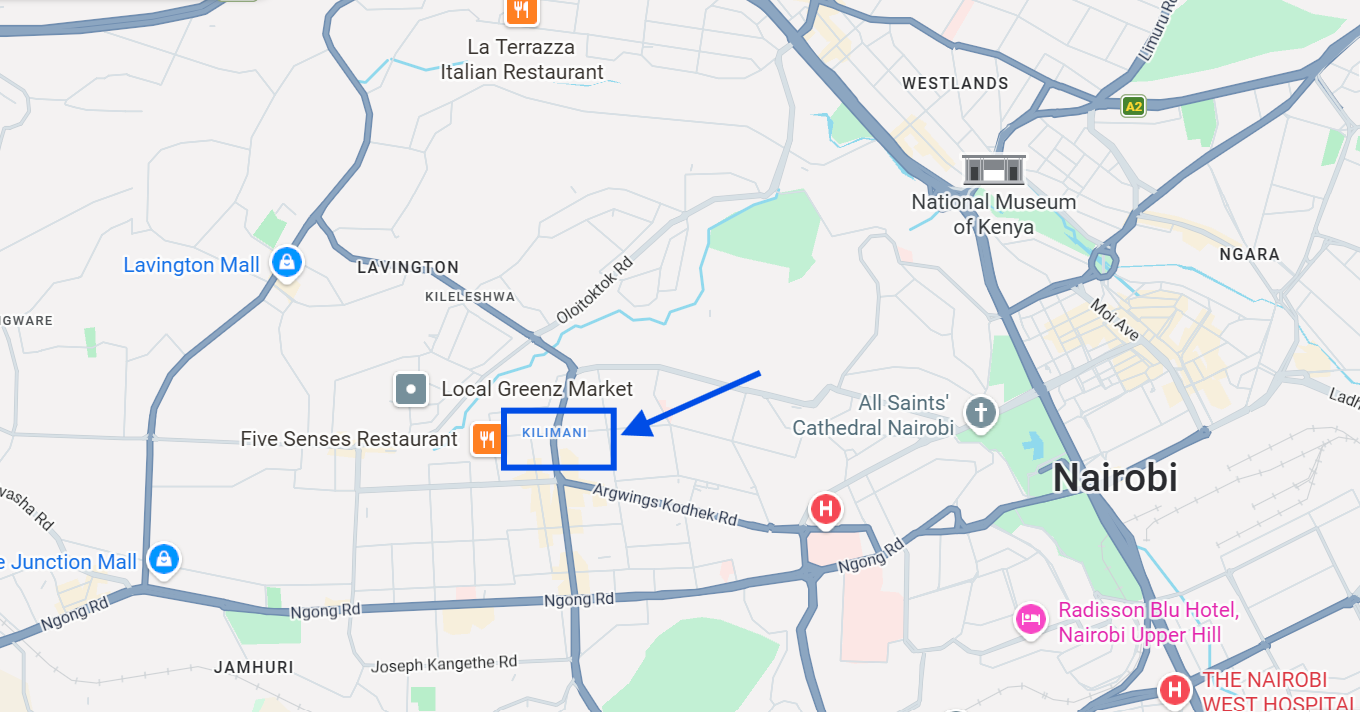
Kilimani lies along three main roads: Ngong Road, Argwings Kodhek Road, and Dennis Pritt Road. It sits roughly 4 kilometres west of Nairobi’s CBD.
Its location between the CBD and Upper Hill is one of its strongest advantages. Upper Hill hosts many of Nairobi’s banks, NGOs, embassies, and regional headquarters, making Kilimani attractive to professionals working nearby.
Approximate Travel Times
| Destination | Outside Peak Hours | Peak Hours |
| Nairobi CBD | 10-15 minutes | 25-35 minutes |
| Upper Hill | 5-15 minutes | 15-25 minutes |
| Westlands | 15-25 minutes | 25-40 minutes |
| JKIA (Airport) | 30-45 minutes | 45-60 minutes |
Travel times depend heavily on Ngong Road traffic, which is one of Nairobi’s busiest corridors during weekday rush hours.
Kilimani borders Lavington to the north, Kileleshwa to the northeast, and Hurlingham to the south. These are all established residential areas.
Transport Options
- Private Vehicles – This is how most residents commute, though parking near commercial centres can be limited during busy periods.
- Matatu Routes (shared minibus public transport): Connects Kilimani to the CBD, Westlands and surrounding areas. Fares range from KES 50 – 100 (Kenyan shillings, roughly USD 0.40-0.80).
- Ride-Hailing Services: Uber, Bolt, and Little Cab operate widely throughout Kilimani, with generally short wait times.
- Traffic Reality: Ngong Road experiences heavy congestion during peak hours (7-9 AM, 5-7 PM). For residents working nearby, this is generally manageable. For longer commutes, it is worth factoring in.
Kilimani benefits from its proximity to Ngong Road, which has undergone major expansion and junction improvements in recent years. While peak-hour congestion remains part of city life, sections of the corridor move more efficiently than they did prior to these upgrades.
For residents working within Upper Hill or the CBD, Kilimani significantly reduces commute time compared to living in outer suburbs such as Ruaka, Syokimau, or Athi River.
What Types of Homes Are Available?
Kilimani is primarily an apartment neighbourhood. Standalone houses exist, mainly near Lavington, but are rare and command a significant premium.
Available Property Types:
- Studio apartments
- 1-bedroom apartments
- 2-bedroom apartments
- 3-bedroom apartments, some with domestic staff quarters (DSQ)
- Furnished and serviced apartments
For specific house options, here are some Sarabi Realty property listings in Kilimani.
Most modern buildings constructed in the past decade include passenger lifts, backup generators, borehole water systems, CCTV surveillance, 24-hour security guards, and parking. Some also have gyms or communal rooftop areas.
Important: Building quality varies widely in Kilimani. Two apartments on the same street can offer very different standards of finishing, water pressure, lift reliability, sound insulation, and management. In Kilimani, the specific building often matters more than the street name.
Day-to-Day Life in Kilimani
Living in Kilimani is urban and active, not quiet suburbia. It is a mixed residential-commercial neighbourhood where most daily needs are within short driving or walking distance.
Shopping and Errands
Kilimani residents can handle most errands nearby.
- Yaya Centre is a historic retail anchor with a supermarket, restaurants, a cinema, pharmacies, banks, and retail shops. It’s accessible to most Kilimani residents within 5-10 minutes.
- Prestige Plaza has a supermarket, restaurants, and daily services.
- Adams Arcade provides further local retail options.
- The Junction Mall, approximately 10 minutes away along Ngong Road, provides a larger retail and entertainment options.
Dining
Kilimani’s food scene is diverse: Ethiopian, Indian, Chinese, Italian, Japanese, and other cuisines are widely available.
Along Argwings Kodhek Road, there is a notable concentration of Korean restaurants and Asian dining options, adding to Kilimani’s multicultural character.
Local cafes, bars, and casual eateries complete the mix.
Fitness and Green Space
Nearby Nairobi Arboretum and Karura Forest offer walking, jogging, and cycling paths.
Many modern buildings include gyms.
Several co-working spaces have emerged in recent years, supporting professionals who work remotely or prefer flexible office arrangements.
Schools Near Kilimani
Within or close to Kilimani:
- Cavina School (private primary and secondary)
- St. Hannah’s Montessori School (early years and primary)
- Riara Group of Schools (primary and secondary)
- Makini School
- St. Austin’s Academy
International schools in Lavington, 10-20 minutes away:
- Nairobi International School (IB curriculum)
- Braeburn School (British Curriculum)
- Braeside School (British curriculum, co-educational)
School fees for these international institutions typically range from KES 500,000 to KES 1.5 million (USD 3,900-11,600) annually, depending on grade level and school.
Families whose priority is direct proximity to international schools often prefer Lavington. Kilimani works best for families comfortable with a short daily drive, though school-run traffic adds time.
Healthcare Access
Residents are within short driving distance of:
- Nairobi Hospital
- Nairobi Women’s Hospital
- Coptic Hospital
- Aga Khan University Hospital
- MP Shah Hospital
Multiple pharmacies and smaller clinics operate throughout Kilimani. Access is generally reliable for routine care.
Infrastructure
- Power -Kenya Power and Lighting Company (KPLC) is the national electricity provider. Most modern buildings include backup generators that activate during outages. Generator capacity varies by building, so confirm this when viewing any property.
- Water – Nairobi City Water provides the municipal supply, though availability can be inconsistent. Buildings with boreholes (underground water sources) and adequate storage tanks offer more reliable access. Always ask about water backup before committing to a property.
- Internet – Fibre broadband is available from Safaricom, Zuku, and Liquid Intelligent Technologies, with speeds typically ranging from 10-100+ Mbps. Mobile 4G and 5G coverage is reliable across most of Kilimani, making it suitable for remote workers and digital nomads.
Security
Security also varies by building rather than being consistent across the neighbourhood.
Modern gated buildings typically feature 24-hour security guards, CCTV, controlled gate access, electric perimeter fencing, and visitor registration. Older developments may not meet the same standard, so viewing at different times of day can provide a clearer picture.
Residents generally use ride-hailing at night rather than walking in quiet areas, choose buildings with visible active security, and stay connected through residents’ communication groups for local alerts. However, these are standard urban practices across Nairobi.
Investment Reality: Is Kilimani Worth It in 2026?
Rental Return Potential
Based on current purchase prices and achievable rents, gross rental yields in Kilimani can range from 6% to 9%, depending on unit size and building quality.
Smaller units tend to perform better. They carry lower purchase prices, attract a wider pool of tenants, and align with the core Kilimani demographic of young professionals.
These are gross figures before service charges, maintenance, vacancy, and any management fees. Net returns typically run 2-3% lower. Calculating realistic net yields before purchase is essential.
What Continues to Work
- Central location near Upper Hill, the CBD, and Westlands is a durable advantage.
- Well-priced 1 and 2-bedroom units in quality buildings near Yaya Centre or on quieter internal streets continue to attract tenants reliably.
- Lower entry prices compared to Lavington and Westlands make Kilimani one of the more accessible entry points for investors in the Nairobi market.
What Requires Careful Consideration
- Competitive rental market – Development activity over the past decade added significant apartment supply across the neighbourhood. Buildings that are overpriced or poorly managed face longer vacancy periods. Well-run properties in Kilimani are less affected.
- Service charges – Buildings with pools, large gyms, or extensive communal areas can carry monthly service charges of KES 8,000-15,000 or more. These reduce net returns and must be included in any honest yield calculation.
- Capital gains expectations – Kilimani is an established neighbourhood. Returns come primarily from consistent rental income, not from buying and selling at a markup within a short period.
Short-Term Rentals: What to Understand Before Going That Route
Kilimani attracts buyers who intend to list their property on short-term rental platforms. Before going that route, several things are worth understanding clearly.
Building Rules
Not all buildings allow short-term rentals. Some compounds restrict stays to less than six months under their bylaws. Others allow it with conditions. Confirming this before purchase is essential since finding out afterwards is costly.
Legal Requirements Exist
Short-term rental operators in Kenya must register with the Tourism Regulatory Authority (TRA) and comply with Kenya Revenue Authority (KRA) tax obligations. Nairobi County business permits also apply. These are legal obligations, not optional steps.
A Competitive Market
Furnished rental supply in Kilimani has grown considerably. Many investors find that corporate stays of one to three months generate more consistent income with lower management intensity than nightly bookings.
Service Charges Apply
Some buildings apply higher service charges to units operating as short-term rentals, given the additional wear on communal infrastructure.
When it works: Premium furnished units targeting corporate tenants on one to three-month assignments, in buildings that permit this use, priced accurately for current conditions, and managed actively or through a property manager, can generate reliable income.
How Kilimani Compares to Nearby Areas
Understanding how Kilimani compares to alternatives will help you make an informed decision.
Kilimani vs Lavington:
Lavington offers larger compounds, a stronger concentration of international schools, lower density, and a quieter environment. Property prices and rents are significantly higher. Kilimani provides more affordable entry, better walkability, and shorter commutes to the CBD and Upper Hill.
Kilimani vs Westlands:
Westlands is more commercially developed with extensive dining and nightlife. Entry prices are broadly similar. Traffic in Westlands tends to be heavier. Kilimani is slightly quieter with comparable rental demand.
Kilimani vs Kileleshwa:
Kileleshwa is more residential and quieter than Kilimani, with less commercial activity. Kilimani offers more shopping convenience and stronger furnished rental demand. Pricing is comparable.
For buyers prioritising rental activity and walkable convenience over compound space, Kilimani often offers the most balanced position between price and demand. Its centrality protects extended vacancy that affects more peripheral neighbourhoods.
For comparison, explore apartments in Lavington or houses in Kileleshwa.
Who Should Consider Kilimani?
Kilimani tends to work well for:
- Investors looking for rental income in an established central location
- First-time property buyers who want a more affordable entry into the Nairobi market
- Young professionals prioritising short commutes to Upper Hill, CBD or Westlands
- Expatriates on one to three-year assignments who want furnished, convenient housing
- Diaspora buyers looking for a ready apartment in a familiar urban setting
- Renters who want walkable access to shops, cafes, and healthcare
Kilimani May Not Suit:
- Families prioritising spacious compounds and extensive green space
- People who prefer quiet, low-density residential environments
- Those sensitive to traffic and urban noise
Working With Sarabi Realty Group
Kilimani has enough variation between buildings, streets, and price points that the specific property you choose matters considerably. Knowing which buildings are well-managed, which locations hold value, and what to verify before signing makes a real difference.
Sarabi Realty Group is active in Kilimani, Lavington, Kileleshwa, Westlands, Riverside, Loresho, and other surrounding areas. We help buyers, investors, and renters find properties that match their actual requirements, not just the broadest search results.
- For buyers, they guide the full process: Identifying a suitable property, conducting a title deed search at the Lands Registry, coordinating review of the sale agreement with a qualified lawyer, and clarifying closing costs, including stamp duty and legal fees.
- For diaspora buyers, Sarabi coordinates Power of Attorney arrangements, which allow purchases to proceed without travelling for every step of the process.
- For renters, they match clients to properties that suit both budget and lifestyle across their active neighbourhoods.
Office: Wanandege Flats Suite A4, Kirichwa Gardens, Kilimani
Contact: (+254) 0700 563 667
More Kilimani listings are available at apartments for sale in Nairobi.
Conclusion: Should You Buy or Rent in Kilimani?
Kilimani is an established, active neighbourhood. It is not an emerging market with speculative upside, but it is also not a neighbourhood in decline. It continues to attract consistent tenant demand because of where it sits in Nairobi and what it offers in daily convenience.
- For renters, the combination of central location, shopping access, transport options, and diverse housing choices makes it one of the more practical decisions in Nairobi in 2026. Current market conditions also mean there is room to negotiate on terms.
- For buyers and investors, returns come from rental income rather than rapid appreciation. The market rewards those who choose buildings carefully, price correctly, and hold with a medium to long-term view. Well-located, well-managed properties in this neighbourhood continue to find tenants.
The difference between a well-performing Kilimani property and an underperforming one usually lies in management quality, service charges, water reliability, and purchase price discipline.
The key to Kilimani is not avoiding it. It is approaching it with accurate information about the specific property, building, and location you are considering. That difference between a property that performs and one that sits empty usually comes down to those details.
Frequently Asked Questions About Kilimani
What is the average property price in Kilimani in 2026?
Property prices in Kilimani vary depending on building quality, location, and amenities. Studio apartments typically start from approximately KES 4.5 million. One-bedroom apartments generally range between KES 6.5 million and KES 9 million. Two-bedroom apartments typically range from KES 9 million to KES 14 million, while three-bedroom units may range from approximately KES 14 million to KES 22 million. Prices depend heavily on the specific building and management structure.
What is the average rent for apartments in Kilimani?
Rental prices vary based on size and whether the unit is furnished.
- One-bedroom (unfurnished): approximately KES 55,000–90,000 per month
- Two-bedroom (unfurnished): approximately KES 75,000–130,000 per month
- Two-bedroom (furnished): approximately KES 130,000–220,000 per month
Actual rent depends on location within Kilimani, furnishing quality, and building amenities.
Is Kilimani a good investment location in Nairobi?
Kilimani can suit investors seeking steady rental income in a central location. Gross rental yields typically range between 6–9%, depending on entry price and service charges. Returns are generally driven by rental income rather than rapid resale appreciation. Careful building selection and realistic pricing are important performance factors.
Can I run an Airbnb or short-term rental in Kilimani?
Not in every building. Some compounds prohibit stays shorter than six months under their bylaws, while others allow it with conditions. Beyond building rules, operators must register with Kenya’s Tourism Regulatory Authority (TRA) and comply with Kenya Revenue Authority (KRA) tax obligations. Nairobi County business permits also apply. Confirm all of this before purchasing with this intention.
Is Kilimani safe for residents?
Safety depends more on the specific building than the neighbourhood broadly. Modern gated developments with 24-hour guards, CCTV, controlled access, and electric perimeter fencing are standard in newer Kilimani buildings. Older buildings vary considerably. When viewing properties, assess the security setup of the specific compound rather than relying on a general neighbourhood impression.
What should buyers check before purchasing in Kilimani?
Before committing to a property in Kilimani, buyers should confirm:
- Title deed status through a Lands Registry search
- Building management structure
- Service charge amount and historical increases
- Generator capacity and water backup systems
- Whether short-term rentals are permitted (if relevant)
Working with a professional real estate advisor like Sarabi Realty Group, familiar with Kilimani’s building-level differences, can help reduce risk.